
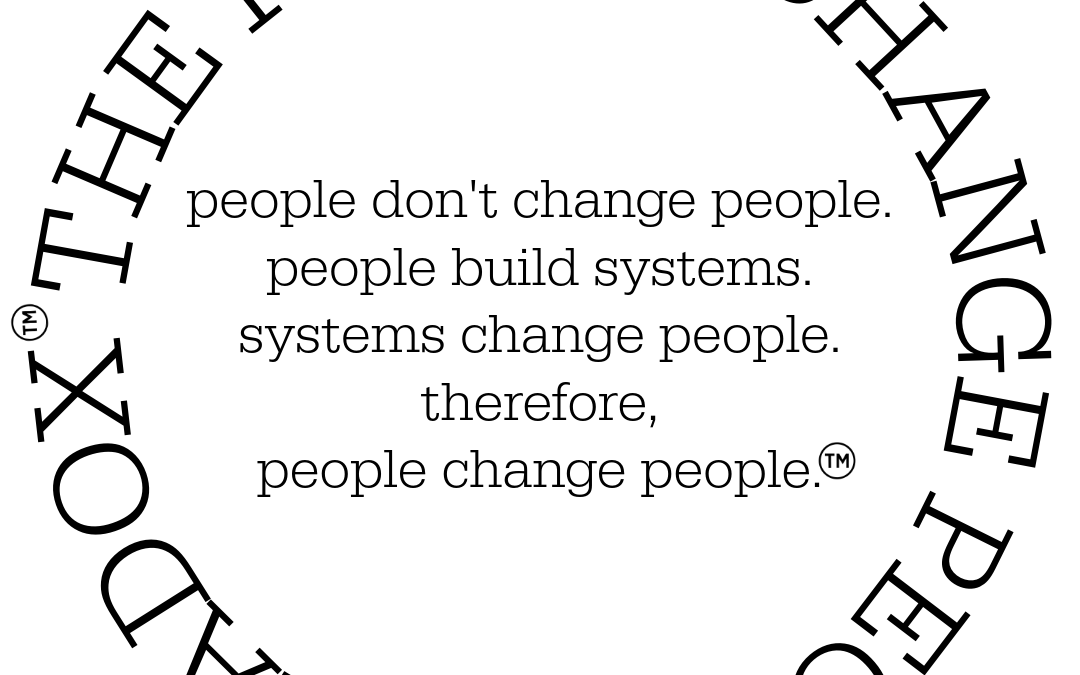
If People Change People™ explains how individuals grow, the People Change People Paradox™ explains something just as important:
Our environments either support our growth or quietly pull us back to who we used to be.
It is a paradox because:
We change because of people.
But people are shaped by the systems around them.
And those systems were created by people.
Which means the cycle is always looping: people, environments, people, environments.
The People Change People Paradox™ gives language to the invisible architecture behind real behavior change, the kind that feels effortless, sustainable, and lived rather than forced.
To understand how these two frameworks work together, it helps to look at both through simple, relatable examples.
People Change People™: How Individuals Grow
At the individual level, change often begins with four relational mechanisms:
1. Relational Safety
We change when we feel seen, understood, and emotionally safe.
2. Identity Resonance
We shift when we are near someone whose way of being awakens something in us, a version of ourselves we want to grow into.
3. Social Learning
Human beings are wired to learn through observation. We mirror the people we trust, admire, or spend time with.
4. Prosocial Feedback Loops
Kindness, encouragement, accountability, and shared effort make new behaviors feel rewarding.
These mechanisms shape everything from the way children learn to the way adults heal to the way communities help one another rise.
People Change People™ is the micro-level truth behind all human growth.
But there is a problem:
Even the strongest individual shifts can fade if the environment around us does not evolve with us.
That brings us to the systemic half of the framework.
The People Change People Paradox™: How Environments Sustain (or Sabotage) Personal Change
We rarely realize how quickly an environment can reshape us:
- Our habits
- Our energy
- Our confidence
- Our identity
- Our sense of what is possible
Most people know the feeling:
You try to get healthier, but the workplace culture undermines you.
You try to establish better boundaries, but the environment rewards burnout.
You try to learn new skills, but nothing around you reinforces them.
The People Change People Paradox™ explains why:
Individual change does not last unless the environment changes too.
Growth requires a setting that removes friction, reinforces new behaviors, and compels a healthier identity forward.
And when the environment shifts, even slightly, something powerful happens:
Change becomes easy.
Growth becomes natural.
Behavior becomes self-reinforcing.
Let us look at a real-world example.
A Case Study: How One Company Changed (By Listening First)
And how the People Change People Paradox™ transformed a culture from the inside out.
When Health401k® partnered with a local employer, we did not start with metrics, movement challenges, or prebuilt programs.
We started with a question:
“Where do you experience friction, personally or professionally, and what would help your day go better?”
Employees told us:
- They wanted healthier lunch options, not lectures.
- They wanted to move more but did not want to sacrifice family time.
- They wanted community and creativity, not another app.
- They wanted easier access to mental health and medical support.
So we made small, intentional environmental shifts, one at a time.
1. Healthier onsite food (subsidized by the company).
Not forced. Just made easier.
2. Onsite movement and strength training.
No extra commute. No friction.
3. Preventative PT screens to give employees a baseline.
Everyone speaking the same movement language.
4. Weekly music and creative workshops.
Community, enrichment, stress reduction.
5. Onsite mental health access and communication sessions.
Help available at the moment it is needed.
6. Onsite labs and care coordination.
No scheduling barriers. No confusion. No overwhelm.
Within months:
- Behaviors shifted
- Energy improved
- Engagement increased
- Identity evolved
- The culture changed
- The environment became self-reinforcing
No one was forced.
No one was lectured.
No one had to rely on willpower.
The environment simply stopped working against them and started working for them.
That is the People Change People Paradox™ in action.
How Both Frameworks Work Together
People Change People™
Describes the human truth of how individuals change.
People Change People Paradox™
Describes the systemic truth of how environments make that change durable.
One is micro.
One is macro.
One is relational.
One is architectural.
One sparks the flame.
The other protects it from the wind.
You need both for sustainable transformation, whether you are a family, a classroom, a team, or an entire organization.
Why This Matters for Organizations, Schools, and Communities
If you want people to grow, do not start with discipline.
Start with connection and environment.
Ask:
- Where does friction exist?
- What would make healthier behavior easier?
- What small shifts would help people feel supported rather than judged?
- What kind of identity do we want this community to reinforce?
Because once the environment supports the behaviors you want to see, change becomes not only possible, it becomes inevitable.
Closing Reflection
People Change People™ explains the spark.
The People Change People Paradox™ explains the system that keeps it alive.
Together, they form the foundation of HealthBroker by Health401k™, a relational and environmental approach to human growth that honors both the individual and the collective.
If we get this right, we do not just help people change. We help them belong somewhere they can grow.
STAY CONNECTED
Services | About | Events | Contact| Trademark & Legal
Services | About | Events | Contact| Trademark & Legal