
Date:Tuesday, February 3, 2026
Location: Wilbraham, MA
Contact: education@Health401k.org for Registration Details
Workshop Title: Piggy Bank Advisor®: Teaching Kids to Make Smart Health Investments
A Signature Workshop Powered by the Health401k® Children & Families Framework
Format: 50-minute workshop
Fields: Child Development · Early Education · Behavioral Science · Parenting · Environment Design
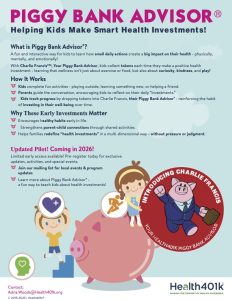
Summary:
Piggy Bank Advisor® is a foundational workshop designed for parents, educators, early intervention specialists, and caregivers working with children from preschool through early adolescence.
Rooted in the Health401k® philosophy that “health isn’t a habit – it’s an environment,” this workshop reframes childhood well-being through the lens of non-traditional health investments, emotional development, early environment design, and social connection.
Participants are introduced to Charlie Francis™ – Your Health401k Piggy Bank Advisor®, and learn how children can build their “health portfolios” through small, playful, developmentally meaningful investments in:
- Heart (emotional & relational well-being)
- Mind (curiosity, learning, attention, imagination)
- Body (movement, energy, rest, sensory needs)
This workshop explores the emerging science around connection-driven development, environmental shaping, relational modeling, and how small, consistent exposures create identity-level change for children.
The session blends instruction, modeling, storytelling, and group discussion – providing families and professionals with a simple, fun, non-competitive structure for helping young children understand why their daily actions matter.
Workshop Elements:
Participants will learn:
- Why environment design outperforms behavior charts, discipline loops, and motivation-based parenting
- How small investments in kindness, curiosity, rest, exploration, and creativity shape identity
- The role of parent–child co-regulation as the foundation for early self-regulation
- How to use Charlie Francis and the token system to reinforce meaningful effort, not performance
- Why experiential rewards build stronger memories than material incentives
- How to help children articulate “what helps my heart, mind, and body feel good?”
- Practical strategies for integrating Piggy Bank Advisor® into homes, classrooms, therapy spaces, and early education settings
Designed For:
Parents & caregivers
Early Intervention specialists
Preschool & elementary school teachers
Pediatric speech, OT, and mental health practitioners
School adjustment counselors & paraprofessionals
Community-based family organizations
Anyone supporting early childhood development
Featured Disciplines:
Child Development · Emotional Intelligence · Environment Design · Identity Formation
Behavioral Science · Relational Neuroscience · Parent–Child Interaction Models
Learning Outcomes:
Participants will learn to:
- Identify relationship-based and context-based factors influencing early childhood behavior
- Design home and classroom environments that naturally encourage healthy actions
- Teach children to understand health as something they invest in, rather than something adults control
- Use simple, playful systems (tokens, storytelling, co-reflection) to build early agency
- Strengthen communication around effort, contribution, and internal motivation
- Create safe, predictable relational environments where healthy behavior becomes the path of least resistance
Discussion Section:
This workshop includes a guided group discussion exploring:
- Non-traditional health investments (kindness, reflection, curiosity, rest, social support, creativity, exposure)
- Personal examples from participants’ families, classrooms, and professional practice
- Community-sourced ideas for expanding Piggy Bank Advisor®
- Feedback on future curriculum development, including:
token design
experiential reward systems
upcoming children’s books
classroom and clinical adaptations
family resources & local collaborations
The goal of this section is to invite the community to co-author the next chapter of Piggy Bank Advisor®, making it stronger, broader, and more accessible for all families.
The Engine Behind Real Change:
“Behavior change in children is a product of environment, not pressure.”
The workshop demonstrates how playful structure + relational connection + meaningful exposure help children internalize healthy identity narratives long before adolescence.
Suggested Use Cases:
Professional development workshops for early educators
Parent nights at schools or family centers
Pediatric clinic family education series
Early Intervention team trainings
Community-building events centered on child well-being
Youth programs seeking to integrate relational health & environment design
Co-branded collaborations with local early childhood organizations