
Leaning into Adria’s world always humbles me.
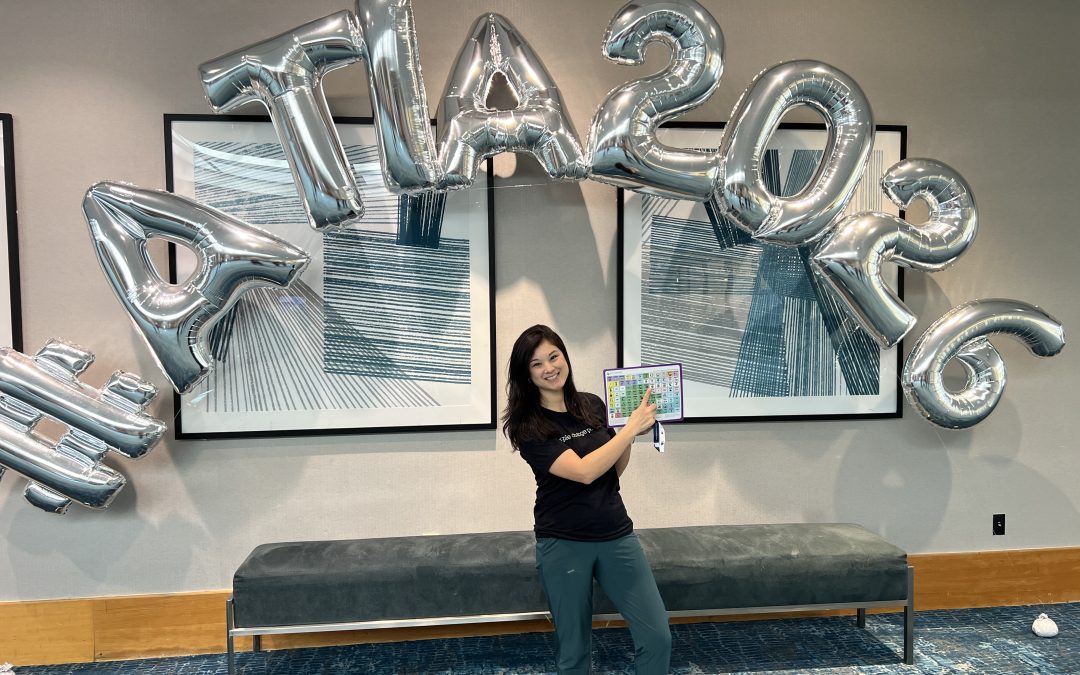
Attending the 2026 Assistive Technology Industry Association’s (ATiA) Conference with her in Orlando was informative, emotional, and perspective-shifting.
Her encouragement to participate, given my lifelong interest in communication was strong and passionate. She felt that seeing firsthand what many face when trying to express themselves, and the strategies and supports built to bridge that gap, would be invaluable.
For context, the ATiA Conference is a national, interdisciplinary gathering of professionals who support people with complex communication needs. It brings together clinicians, educators, technologists, researchers, advocates, and families. It focuses on how assistive technology and augmentative and alternative communication (AAC) systems help individuals express themselves, participate fully, and connect with others. The conference highlights practical tools, collaborative care models, and human-centered approaches that make communication accessible across schools, clinics, homes, and communities.
It crystallized that people change people™ is not just our North Star and educational framework.
It is a life principle.
The experience was deeply emotional.
It reflected the distance between:
- what I still take for granted
- and, what others work tirelessly to access
And the quiet miracle that people, together, build bridges across that distance.
I was not moved by inspiration.
I was moved by evidence.
Evidence that when environments are designed for and with care, people rise to meet one another.
We often hear:
- slow down
- do not react
- do not simply wait your turn to speak, truly listen
There is an age-old aphorism, “seek first to understand”. That fundamental rule of communication served as part of the bedrock of this entire event.
Communication is a two-way street
Adria shared something that stayed with me.
Communication is a two-way street. For individuals with complex communication needs, there is often pressure on how to get them to communicate. But we rarely pause to examine our role in the exchange. Being a good communication partner is essential to their success.
That does not end with assistive technology.
It applies to every relationship.
If we want a successful communication exchange, we have to step back and listen.
In our presentations, I often say:
- Speaking the same language is often one of the largest barriers to communication.
- When there is a language barrier, we do not assume malintent or low competence.
- We recognize the hurdle for what it is.
But when we speak the same language, we stop being careful.
We forget that words carry both objective and subjective meaning shaped by a lifetime of exposure, experience, and context.
We understand words in isolation, but not the symphony of meaning that forms from a lifetime of exposure and experience… through a lens we will never fully share.
This conference created a forced pause.
It slowed the exchange long enough to aim for real understanding.
Across the conference, I saw this same principle expressed through many forms of access including digital feeding technology, low vision supports, hearing access tools, and layered communication systems. Different needs. Different tools. The same truth.
A standout moment for me was meeting and learning from Mateo Moreno, a young adult AAC user who has been communicating with a speech-generating device since age four and now speaks nationally about inclusion, disability, and communication. He presents to students, families, and professionals across the country, sharing his lived experience and practical guidance for communication partners. Through speaking, mentoring, and advocacy, Mateo helps others see what becomes possible when people are truly heard.
Mateo slowed the room down.
- People leaned in.
- They listened.
They did not interrupt.
Conversation unfolded without force.
In real time, for three days, presenters, participants, and advocates demonstrated what it means to truly listen to one another without agenda and with the pure intent to understand.
This was a masterclass in what it means to genuinely communicate.
Mateo’s story did not stand apart from the ecosystem. For me, it gave part of it a face.
It also crystallized that sometimes the most powerful health investment is simply seeing what others have to build to survive.
Not as sentiment.
But as reverence.
Running into Mateo, inside and outside the conference, was meditative and humanizing for both of us.
How this experience showed up in my Health401k®
This experience revealed the same truth across every dimension of health.
When we slow down and truly listen, people rise to meet one another.
- Emotional: It forced recognition of what I take for granted and deepened my connection to the population Adria works with daily.
- Environmental: It pulled me out of my day-to-day and into an ecosystem built to bridge gaps.
- Intellectual: It expanded my awareness of what already exists and how layered strategies can improve communication across contexts.
- Occupational: It sharpened how I want to sit with clients by slowing the pace even further.
- Social: It introduced new communities, contexts, and connections.
- Spiritual: It reminded me what presence feels like through eye contact, silence, stillness, and being fully with another person.
Different dimensions.
Same principle.
People change people.
Through presence.
Closing Reflection
Mateo shared a series of reflections on his work as an advocate.
This quote from one of his attendees stayed with me:
- “When an AAC user shares their experience, people are instantly engaged. Everything they’ve heard could happen if we model and presume competence is now right in front of them. Not only are they able to learn from an AAC user, they see Mateo’s ability to connect with people and his sense of humor.”
With or without realizing it, Mateo has created a communication bridge that spans all communities.
When we presume competence, we listen differently.
When we presume positive intent, we respond differently.
Mateo also shared a pet peeve that extends far beyond AAC:
“Pretending you understand me when you do not.
Just ask me to tell you more.
Ask clarifying questions.
Communication breakdowns happen all the time, with everyone.”
Practical takeaway
These lessons are not limited to assistive technology, healthcare, or conferences.
They apply in our relationships, families, workplaces, and every moment where understanding matters.
The invitation is simple:
- Slow down.
- Ask.
- Listen.
- Presume competence.
- Presume positive intent.
That is where connection and understanding begins.
This entire experience, leaning into Adria’s world, what she loves, the population she supports, and getting to know her work more intimately, in addition to the invaluable takeaways and social connections I made, was a massive investment in our relationship.
Closing Question
What lessons have you learned from leaning into your partner’s, friends, or families interests?
Ryan Travis Woods
STAY CONNECTED
Services | About | Events | Contact| Trademark & Legal
Services | About | Events | Contact| Trademark & Legal